The waka poem by Ono no Komachi, which inspired the track
YUTORI, is a masterpiece that expresses a deep sense of longing and impermanence
regarding the fading of youth and beauty. "Just as even the most beautiful flower
loses its color past its prime, my own beauty fades away with time" — such
a poignant, fleeting aesthetic. Furthermore, as depicted in the Noh play
Ono no Komachi, there is a "dignified elegance and beauty that lingers
amidst the shadows" of Komachi, once celebrated as a matchless beauty, even as
she grows old. These qualities are precisely why her work continues to be passed
down to this day as the embodiment of Mono no Aware (the pathos of
things), an aesthetic tradition spanning from the Heian period.
The concept of "aging" that Satoko Shidahara, who was in charge of hair
and makeup, sensed from the track YUTORI was deeply intertwined with this very
aesthetic of Komachi. Furthermore, just as Matsuo Bashō discovered the
workings of great nature and the impermanence of time in a single fallen leaf,
Japanese aesthetics have since ancient times sensed a universal beauty within
subtle, fleeting changes. This aesthetic eye — sensitively capturing
"momentary signs and textures" such as the touch of the skin, the sway of the
wind, and the changing of the seasons — lives deeply within our senses,
much like how it richly nurtured onomatopoeia to give expression to the very
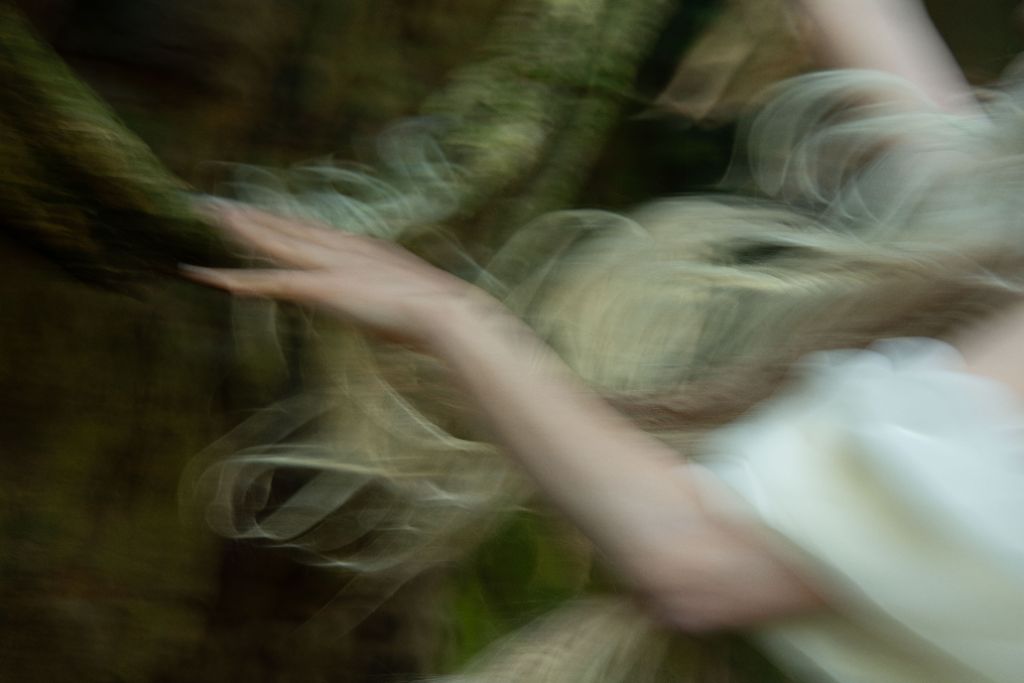
sound of words. The frames captured by Asami Watanabe, who led the art
direction and photography, vividly captured that quiet presence and atmosphere,
fixing that momentary beauty into eternity.
Sprouting, blooming, and eventually quietly withering to fall and return to the
soil — the raw, natural environment of the shooting location, along with
the touch of the wind and the shifts of light, powerfully told the story of the
cycle of life and the beauty of "aging." Humans, too, are by no means beings
detached from the workings of nature.
In modern society, where the value of youth and physical beauty tends to be
overly emphasized, I feel that many women — including myself — live
with anxiety and conflict regarding the act of "growing old." That is precisely
why visualizing and presenting "aging beauty" as art amid the light and shadow
of mother nature holds great meaning. It is a story that passes down inherited
aesthetics from the past through us to the future, and I hope it serves as a
"hope" that allows women living in the same era to embrace and affirm
the process of aging.
The Ubara Coast in Katsuura, where the waves of the Pacific Ocean crash ashore.
The stance of the torii gate standing at the boundary of the blue sea and sky
appears almost like the kanji character MA (間 — space / pause)
itself. Since ancient times, the Japanese people have believed that deities
reside in all things, cherishing that sacred presence and empty space as
MA. The landscape unfolding through the boundary of the torii gate
makes one feel a momentary miracle where the visible and invisible worlds, as
well as humans and the sacred, overlap.
"What I seek is a mirror that reflects me"
"Inside the mirror, I see you"
"In the light, I appear"
What is portrayed in the lyrics is not a search for something on the outside,
but a mystical lyrical narrative of quietly confronting one's own inner essence
— or a grand existence — through a mirror (shinkyō, divine
mirror). Beneath the torii gate of Ubara Coast, where the sea breeze and light
intersect, words and sounds become MA, released into the light. In
this land where deities dwell in everything, this artwork depicts the amplitude
of an unextinguishable love, confronting oneself through the mirror that
reflects the self.
Though shot at the same Ubara Coast as MA, this location strips away
the symbolic torii gate to confront primitive nature — an endless sea
and carved rock surfaces. Enveloped in the sound of crashing waves amid the
silence of morning mist, it depicts a dignified figure taking a new step
forward.
"What changes, changes. I will resist no more."
Reflecting the lyrics' message of accepting changing destinies and the
transformation of loved ones, the figure reflected in the waves represents the
"passing past," while the physical entity living in the present represents the
"future to be walked." The ebbing and flowing waves are time itself, where
past, future, and present intersect. This is not despair, but
"regeneration and a powerful step forward" found beyond serene
acceptance. Amidst the sound of the era's waves, the artwork carves out the
beauty of simply standing as oneself.
Kameiwa Cave is filled with a sacred atmosphere, as if ancient time has
stopped, with mystical light shining from the depths of the cave and reflecting
on the water's surface. Captured within this extraordinarily quiet location is
the "pulsation of life" welling up from within oneself, entirely
detached from the noise of the outside world.
"My skin already knows, I feel it with my skin"
"Before my heart does"
"Before I touch your warmth"
The lyrics portray an overwhelming world of intuition, sensing "warmth" and
"presence" instinctively beyond reason or thought. Resonating with the energy
of the sacred cave, the skin trembles, and blood circulates. The dynamic
sensation of "life" existing surely within the silence is elevated into artwork
through light, shadow, and tense physical expression.
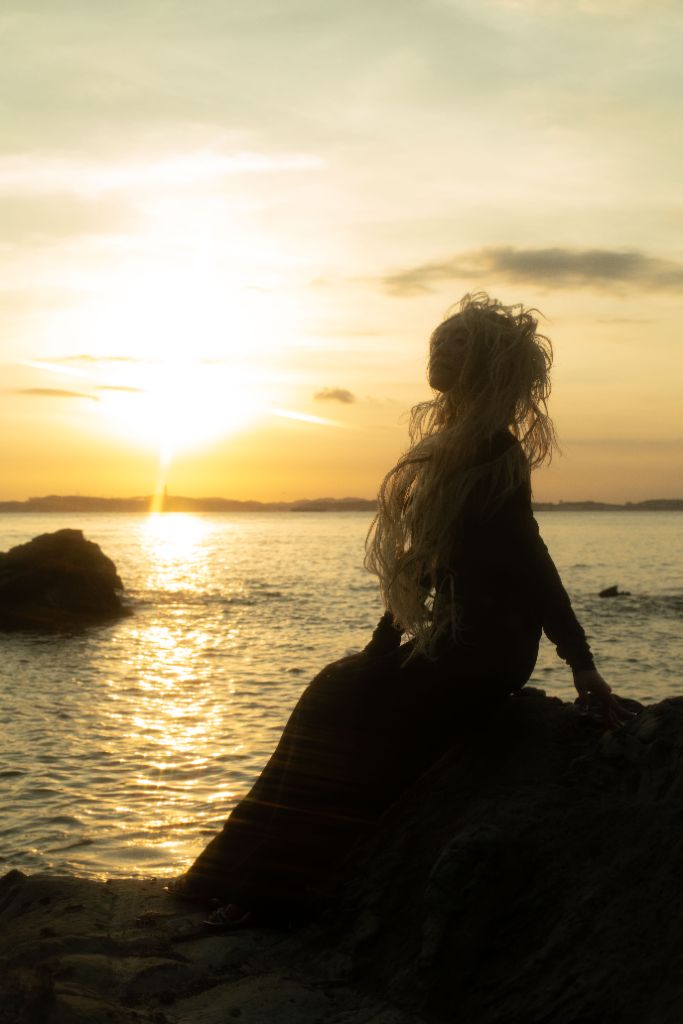
The beach of Futtsu, where the sun slowly dips toward the horizon, gently
dyeing the sky and sea from gold to madder red (akane). Captured
during the fleeting twilight right before sunset is a sweet, dramatic moment
where the madder red of nature overlaps with feelings welling up from within
in front of a loved one.
"As you draw near, I cannot hide it — my cheeks flush first"
"Faster than words, flushing softly like the evening glow"
Expressed in the lyrics is a youthful romantic feeling where overflowing joy
and excitement manifest as physical sensations faster than any words.
Silhouettes floating in the backlight, and the light of the setting sun warmly
enveloping the world. The madder red dyeing the sky and the joy flushing the
cheeks resonate together, capturing a moment where the warmth of mother nature
and pure human emotion melt into one.
A nighttime garden where the sun has set, deepening the silence and shadows.
Treating the secret light glowing in the darkness as a metaphor for
"bleeding city neons," this symbolic portrait places a bold focus on
facial expression and hairstyle. The original song was inspired by Ono no
Komachi's intense yet noble waka poem:
うらみやと思はば思へ 我が恋は うらむるかたに 燃えこそまされ
If you think I grudge you, think as you will.
For my love only burns hotter when met with resentment or hardship.
"Beneath the bleeding neon, your shadow traces my skin"
"Even if the rain erases the traces, your eyes are like a blade"
Oozing through the lyrics is the strength of a passion that transforms even
pain and conflict into fuel for love. The sharp gaze piercing through the gaps
of delicately swaying, intricately braided hair resembles a "blade" cutting
through the dark itself. Within the secret light and shadow highlighted by
the powerful close-up shot of the face and hair, the artwork depicts an
unextinguishable, strong will of love.
Nomizo Waterfall, surrounded by lush green woods and pure flowing water.
Standing amidst the sunlight filtering through the trees, absorbing the breath
of nature with one's entire body, symbolizes a peak reached in the narrative
of the album YUTORI. The original song was inspired by Ono no
Komachi's poignant yet ultimate poem of affection:
忘れじの 行く末までは 難けれど 今日を限りの 命ともがな
Though I cannot hope for an eternity promised by "I will never forget you,"
if I am fulfilled in this single moment, I would not mind if my life ended today.
"Soles of my feet on the earth… Close my eyes… Breathe…"
"Who am I… Without searching for an answer, I simply am"
Spoken in the lyrics are quiet words of meditation — letting go of
thoughts and emotions, and deeply gazing inward. Komachi's aesthetic of staking
one's entire life on "this single moment today," and the process of diving
into inner silence to return to one's "true self." Amidst the sacred
light of nature and the circulation of water, the artwork depicts a moment of
soul liberation and prayer — realizing that the answer one was searching
for was already "right here" (within oneself).
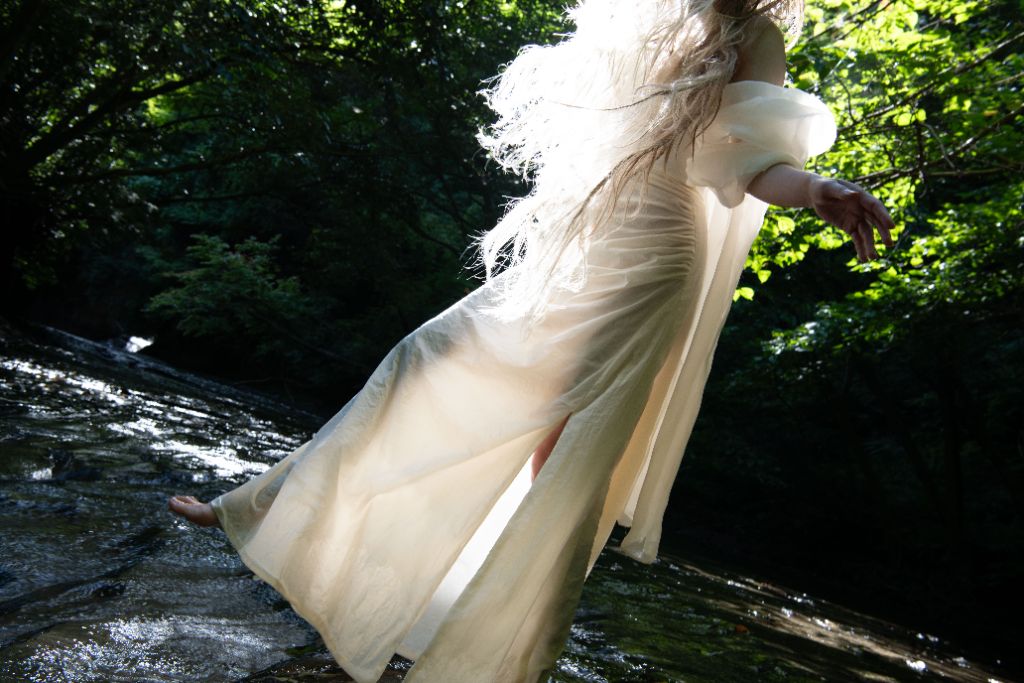
A sacred location at Nomizo Waterfall, surrounded by deep greenery, where
dazzling light pours down from above. Wrapped in backlight, with hair and
garments seemingly melting into particles of light, the image captures the
very moment the boundary between reality and dreams dissolves. The original
song was inspired by one of Ono no Komachi's representative love poems:
思ひつつ 寝ればや人の 見えつらむ 夢と知りせば 覚めざらましを
Did you appear because I fell asleep thinking of you?
Had I known it was a dream, I would never have opened my eyes.
"When I close my eyes, I touch you"
"A dream gently falls, guiding me to the light"
Contained within the lyrics are the poignant feelings that can only be touched
by closing one's eyes, and the guiding light provided by that dream. By closing
one's eyes and diving deep within oneself, one realizes the truth that
"happiness is not something given by someone else, but was already
abundant within oneself from the beginning." The memory of a fleeting
dream one wishes never to wake from, and the overflowing light — all of
it is a rich world within oneself. The dazzling sunlight filtering through the
trees at Nomizo Waterfall melts together with the inner light, depicting a
fantastical scene that leads toward true happiness.